
2️⃣ American Executives Shed Crocodile Tears for Oppressed Black Workers
Tim Smith confronts a "Special Police" looking for "terrorists" while visiting GM facilities, returns to present before Congress, and organizes a revolutionary coalition.

Part 2 of The Godfathers, a real-life story about a controversial church group’s campaign to end Apartheid that revolutionized the global economy. If you missed it, read my intro or start from Part 1.
Dear Walkers,
You won’t want to miss today’s installment of The Godfathers. After months of frustrating conversations with the CEO of General Motors, Tim Smith fundraises for a two-month visit to South Africa for an up close look at how black workers were treated at American-owned factories. You won’t believe what he found or his dangerous encounter with the Apartheid “Secret Police.”
Enjoy!
Ryon
The Godfathers (Part 2)
Crocodile Tears
In July 1970, about a year before the annual shareholder meeting, Tim Smith arrived at the YMCA in Johannesburg. His mission: gather intelligence and write a comprehensive report on American corporate subsidiaries in the Apartheid state. He personally fundraised for the two-month stay by visiting the offices of racial justice groups in Manhattan. Sympathetic church leaders had gone above and beyond, using connections to get him letters of introduction from home offices in the United States to the heads of subsidiaries in South Africa.
Smith may have been the first to visit American-owned factories with the intent to challenge the local government. It was a road fraught with danger as any person advocating economic boycott in South Africa could be tried for treason. Local news reports had warned the public to keep an eye out for “trained terrorists” entering South Africa to “brainwash” youth.
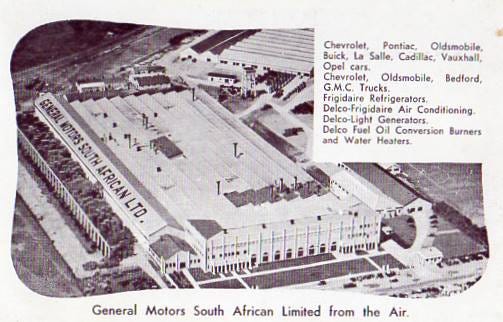
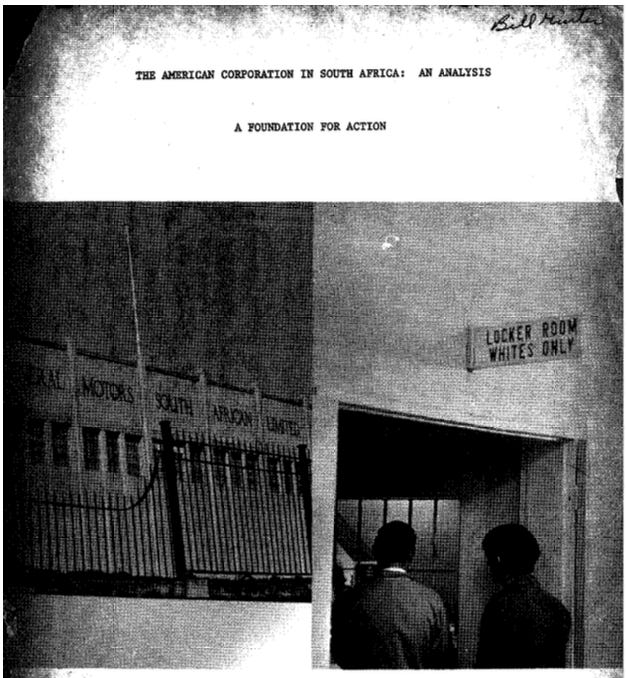
Tim was warmly received by the Managing Director of General Motors South Africa Limited. William Slocum proudly offered the young white Christian a tour of the facilities. As the tour guides walked ahead, Smith snuck a picture of a “whites only” sign above an entrance to the locker rooms and some stairs that were segregated.
Africans “lack reasoning power,” explained one factory guide. They “enjoyed repetitive work,” and had “no depth perception.” Smith bit his tongue to keep the conversation flowing. Quotes like those would be gold for his report.
“I wouldn’t say these people (Africans) don’t have any reasoning power,” reasoned a GM Plant Manager, “but that what they do have is very limited.” GM only promoted black workers when a white person could not be found to fill the role, and, even then, paid them a fraction of what whites earned for the same work.
Back at Slocum’s office, Smith fumbled a bit with his tape recorder. The friendly executive helped the inexperienced interviewer set the machine to record. Slocum was open with the fellow white Christian from a church group back home. He seemed genuinely proud of GM’s role in South Africa.
“The job opportunities we provide would not be provided without us,” he said, adding, “we are in the forefront of progressive change.” Smith wasn’t sure how progressive exactly as the separation of races inside the factory was the same as in the streets.
General Motors wasn’t the worst of the twenty American-owned factories Smith visited while crisscrossing the country. At Ford Motor Company of South Africa, the Managing Director was shockingly honest: “I don’t mix with [blacks] in the States; I don’t mix with them here, and if I went back to the States, I wouldn’t mix with them there either.”
Others told him it wasn’t a good idea to raise wages for Africans because they would just waste the money. “If you saw these Africans on Friday afternoon after payday,” explained the executive at John Deere, “you would see that they are not quite human.”
Smith recorded dozens of quotes that would have gotten executives in hot water or even fired in the United States. American companies were withholding workplace rights considered essential back home. To a man, the executives insisted that progress had to happen incrementally in South Africa, lest the nation devolve into communism. Majority rule too soon, they argued, would surely devolve into “complete chaos.”
There was little regard for the daily oppression of black South Africans. As the economy had expanded, Apartheid had hardened. Nonwhites had lost representation in parliament, black opposition parties were banned, and black unions were not recognized. Naturally, executives wouldn’t want to slow the end of Apartheid - their annual bonuses partly depended on cheap labor.
At Goodyear, a sympathetic executive gave Smith a heads up: the Special Branch had phoned to quiz him about their conversation. Smith had a message waiting for him at the Y from a detective requesting an audience. He later met the sickly pale officer with icy blue eyes. He grilled Smith with that thick Afrikaans accent - like an inquisitive Nazi in an all-English war movie. Vhy are you here? Vhy interview so many executives?
Smith told the truth. He was part of a Christian church group doing research. Religious groups weren’t known for interfering in business activities. He wasn’t a journalist or some politician. Smith was honest but careful not to trash Apartheid as the officer dutifully jotted responses on his little notepad. There was no overt threat, but Smith got the message. “Ve’ll be in touch,” concluded the officer.
Tim Smith interviewed scores of executives, union leaders, journalists, publishers, economists, professors, and government representatives. Friendly pastors set up secret meetings to speak with black workers outside factories. His report juxtaposed the views of white Americans and South Africans with those of Africans, Asians, and Cape Coloureds.
Before leaving, an official from the U.S. Embassy in South Africa confided: “I used to hope that we could get the American businesses here to move off their bottoms and do something. But we are putting pressure at the wrong end. The pressure should be applied in New York or in Detroit.”
A Convenient Excuse
Special Branch officers were right to worry about Tim Smith. His explosive report, “The American Corporation In South Africa,” provided invaluable insights for the broader anti-apartheid movement. It was first-hand information never collected before that was hard to dismiss, even for willfully uninformed executives in Detroit and elsewhere.
Interviewing twenty out of two hundred American-owned subsidiaries may not have been a representative sample. A government mandated survey with standardized questions would have obviously been ideal, but that kind of support was “not in the offing.” Still, consistent answers at every subsidiary allowed Smith to confidently conclude: “Fact is that American business and American businessmen assist in perpetuating and strengthening the racial status quo in South Africa.”
Based on his eye-opening report, Smith was invited to present before the Subcommittee on Africa of the U.S. House of Representatives. Charles Diggs, whose district included GM’s headquarters in Detroit, chaired the committee as part of a decades-long struggle for sanctions against the Apartheid regime. As the first African American congressman from Michigan and the founding chair of the Congressional Black Caucus, he’d openly criticized the White House for supporting the white supremacist government in South Africa.
Smith confirmed that American influence had made the Apartheid regime bolder and ever more self-sufficient. American investments in the auto, oil, and rubber sectors assisted in building South Africa’s military potential. Trucks sold to the South African army showed how a “neutral economic investment” aided and abetted the regime.
“When a corporation provides important materials, know-how, or equipment for use directly or indirectly in the process of oppression,” Smith told congressional leaders, “It is both morally and politically implicated in their use.”
A “liberal” company in South Africa was easily classed as exploitative and unjust by international standards. Corporations in the U.S. had recognized by then that hiring, training, and promoting African Americans was necessary to retain social credibility. In South Africa, it was a “non-question.” A full seventy-seven percent of the executives Smith interviewed for his report supported Apartheid as an attempt to “find a solution.”
Even if American corporations provided small gains for black workers, the result was a nation of slightly better fed political and economic serfs. As the former Prime Minister, John Vorster, had plainly stated: "We know one person only to whom we owe an explanation and that is the white worker in South Africa.”
Confounding political efforts during the Cold War was that Nelson Mandela’s banned political party received funding from the Soviet Union. Smith and Diggs understood that accepting those donations was an act of desperation given no western nation would fund their cause. Mandela wasn’t a communist, they argued, nor did he plan to implement a Soviet-aligned government.
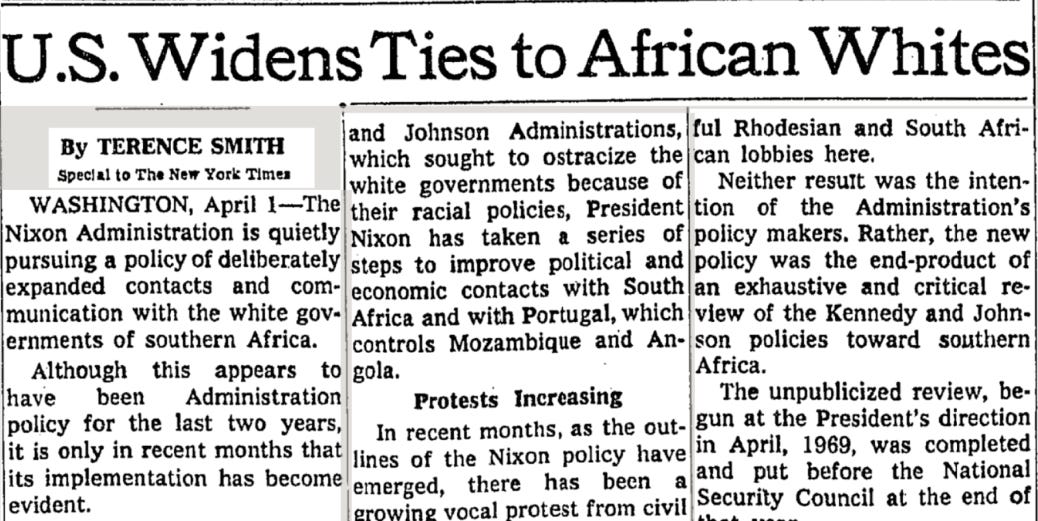
At the height of communist paranoia, President Richard Nixon refused to support sanctions. “We must analyze where our national interest lies,” he had said, “and not worry too much about other people’s domestic policies.” Nixon played into the hands of National Party leaders in South Africa who expertly exaggerated the “communist menace” as a convenient excuse to justify white minority rule.
Social conservatives in America consistently thwarted efforts to sanction white nationalists in South Africa. The Apartheid regime had also banned porn, gambling, works by Marx, Lenin and other “dangerous” socialists. Cinemas, shops selling alcohol, and most other businesses were closed by law on Sundays. Abortion, homosexuality, and sex education had also been severely restricted.
Sweeping government policies would have clearly been preferred to piecemeal corporate action, but church activists and the broader anti-apartheid movement could not depend on the White House. With profitable economic relations and abundant mineral resources, the United States continued to deepen ties with South Africa.
Read Part 3 of The Godfathers where the Episcopal Church holds an “emergency meeting” to decide the fate of a controversial plan that would revolutionize capitalism.