
3️⃣ Episcopal Church Holds "Emergency" Meeting to Address Conservative Pushback on "Radical" Efforts to End Apartheid
Archbishop John Hines must decide the future of the Episcopal Church as conservative members "stage a revolt" against "radical" efforts to end Apartheid.

Part 3 of The Godfathers, a real-life story about a controversial church group’s campaign to end Apartheid that revolutionized the global economy. If you missed it, read my intro or start from Part 1.
Dear Walkers,
Today we walk a mile in the shoes of the Archbishop of the Episcopal Church at critical time in the church’s history. Will he appease disgruntled conservative parishioners or ride the “bucking bronco of a polarized church?” What he decides will help change the course of history, revolutionize the economy, and launch a trillion-dollar industry on Wall Street.
Enjoy,
Ryon Harms
The Godfathers (Part 3)
You Are the Church
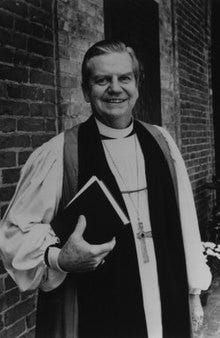
Back at Cobo Hall in Detroit, Tim Smith spotted a deep purple cassock with a wraparound white collar among the otherwise somber business suits. John Hines, Presiding Bishop of the Episcopal Church in America, was chatting on the opposite end of the ballroom as everyone shuffled toward their seats to start the shareholder meeting for General Motors.
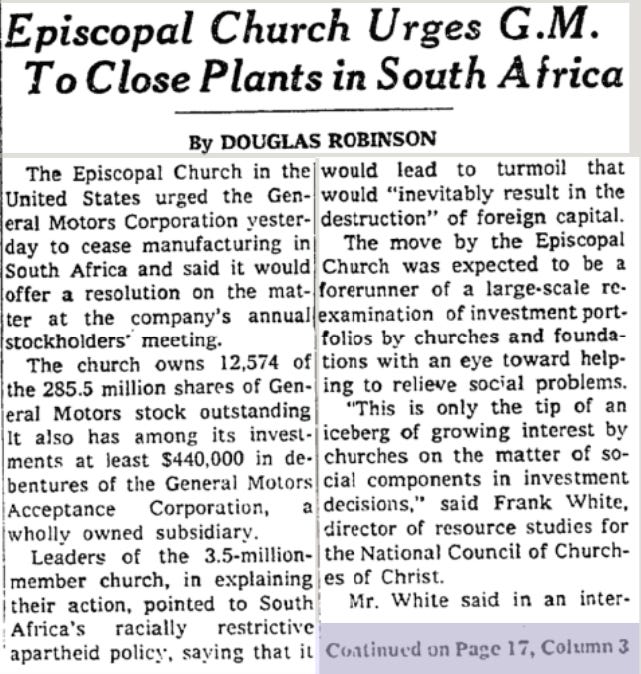
Days before the event, Bishop Hines had dropped a bombshell. In a public letter that made the front page of the New York Times, he urged GM’s Chairman, James Roche, to cease operations in South Africa. “We believe that the Apartheid policies presently pursued by the Republic of South Africa will lead inextricably to great instability and turmoil in South Africa, which would inevitably result in the destruction of the Church’s investments in General Motors.”
Episcopalians numbered in the low millions but had an outsized influence in American politics and business. Its deep colonial New England roots gave the church a “high class” reputation and attendant wealth. In his quest to “erase all vestiges of racism” from church life, Bishop Hines established the first Committee on Social Responsibility in Investments. Its first mission was to identify companies within the church’s massive endowment investments that contributed to or enabled Apartheid.
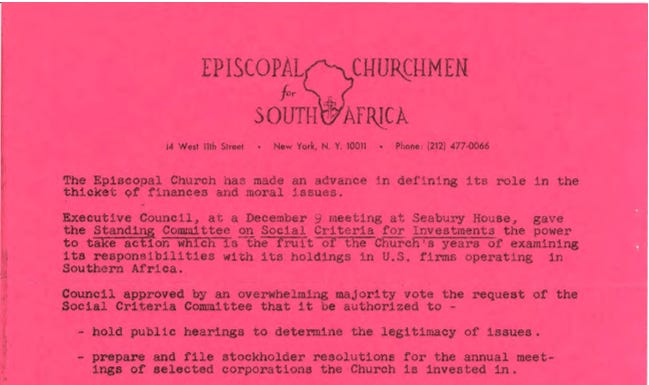
“That we possess considerable economic power is obvious and undeniable,” wrote the investment committee in a church bulletin. “What has not always been so obvious is the necessity for this Church to use its economic power for Godly purposes in the framing of a more just and equitable society.”
Dozens of companies in the church’s investment portfolio had business interests in the Republic of South Africa. Standard Oil, Texaco, Firestone Tires, and General Motors were found to be “essential to the development of South Africa as an industrial state.”
GM was singled out. It was “quite clear” that since Sharpeville, the manufacturing powerhouse had “willingly” helped South Africa become industrially and militarily self-sufficient. In the event of what church leaders feared was an imminent civil war, the company’s plants would be a critical source of trucks and armored vehicles used to kill and detain civilians.
Since dialogue with management had failed, committee members debated a more aggressive and somewhat unique approach: filing a shareholder resolution. When management at public companies like GM failed to act, resolutions allowed investors to take concerns directly to other shareholders. If enough of them voted in support of the resolution, it could persuade GM’s Board of Directors to push management to act.
Shareholder resolutions were rare and often press-worthy because they pitted shareholders against management. They took on heightened urgency because they were voted on in the short time leading up to an annual meeting. A final vote total also gave coverage on resolutions a satisfying conclusion. It would be a few principled church activists versus the corporate world’s undisputed Goliath. No church had ever filed a resolution and only a handful had ever filed one related to social issues.
Institutional investors like university endowments and public-benefit foundations would be forced to debate the resolution and take a stand. A public contest covered by the national press would also force GM’s management to respond in a way that would appeal to the public, not just the profit instincts of shareholders.
General Motors had made it clear that “a corporation can only discharge its obligations to society if it continues to be a profitable investment for its shareholders.” According to social activists, it was time to rearrange those priorities: a corporation should be allowed to be a profitable investment for its shareholders only if it met its obligations to society.
Bishop Hines moved boldly to file the resolution.
After seeing the resolution, GM’s Chairman James Roche spoke at the Executive Club of Chicago: “The crusade for radical changes in our system of corporate ownership,” he told members of the Executive Club of Chicago, is “so drastic they would all but destroy free enterprise as we know it.” From the perspective of Roche and most of the investment community, church activists were more concerned with social goals than with the financial health of the company, and thus were not “real shareholders.” To Roche and most of the investment community, activists were trying to achieve in Detroit what they could not achieve on Capitol Hill.
General Motors challenged the resolution at the Securities and Exchange Commission (SEC), a final arbiter of what was allowed on a company’s agenda for the shareholder meeting known as a Proxy Statement. In GM’s “no action” objection to the SEC, the company opposed the resolution because “the cost of liquidating the highly specialized facilities in South Africa would be considerable and would also result in the loss of a well‐established source of earnings.”
The Chairman of the Commission at the SEC, who had been appointed by Nixon, by “some miracle” rejected GM’s request and allowed the church’s resolution on the Proxy Statement.
Leading conservatives in the Episcopal Church “staged a revolt” when they heard about the resolution. They called for an emergency late night meeting near New York City where one church leader asked, “Does the Episcopal Church want to stage a revolution in South Africa?” A fair question considering that the Church had provided humanitarian funding for the African National Congress, an organization labeled a “terrorist” group by the local authorities.
“We are heading down a road not knowing where we are going,” complained another member of the Executive Council. “If we do this to General Motors, we open the doors to examinations of all companies in the United States!” Then came what church activists at the meeting considered the clincher, “The bishops in Detroit are embarrassed!”
Bishop Hines was used to ruffling feathers. He saw sacrifice in the name of standing up for the oppressed as a kind of “ecstasy.” His support for ordaining women and minorities, among other efforts, had provoked dissent, leading some congregations to lose significant membership that drastically reduced tithings and the church’s national budget. Despite the financial costs to the church, he was resolute, preferring to remain “astride the bucking bronco of a polarized church.”
Even liberal activists had qualms. “It seems very strange that the church sold its strongest possession - its moral and theological tradition in order to … fit the slit hole of economic advantage.” They argued, “At no point in Bishop Hines' letter to the Chairman of the Board of General Motors does he refer to God or to moral judgment or to the evil of Apartheid.”
Hines had argued in the letter to GM’s Chairman that Apartheid would lead to turmoil that would be bad for the church’s endowment. One church supporter asked, “Does that sound very convincing to you?” He added, “Even if you could show that turmoil will be coming (you can), it would equally well be argued that the better thing to do [for the church’s endowments] is to get the United States to beef up its support of the armed forces of the Republic of South Africa.”
Late into the meeting, a church elder cleared the air: “We’ve talked about corporations, profits, the health of corporations, even the embarrassment of the bishops in Michigan. What we really should be talking about is the health of people, black people living under oppression.” Eventually, the debate was resolved with an agreement to add a preamble to the shareholder resolution that softened the demands on General Motors.
A church bulletin encouraged local parishes to hold public hearings and invite exiled South Africans to speak to the horrors of apartheid in anticipation of the upcoming shareholder meeting. It encouraged everyone to purchase a share of GM stock so they could speak at the annual meeting in Detroit, though that was controversial as it fed the perception that church activists were not real shareholders. The bulletin also recommended everyone read the report on American corporations in South Africa by Timothy Smith.
However, the Church could not simply file a resolution asking management to do the right thing. They had to address a “material” issue relevant to the company’s bottom line. It couldn’t be “overly prescriptive” or “too vague.” A law professor and member of the Episcopalian investment committee, Paul Neuhauser, was tasked with writing the resolution with help from an experienced legal firm on Wall Street.
Tim Smith helped organize the larger interfaith community of protestant denominations to vote for the resolution. When church leaders realized they held stocks in companies supporting Apartheid, they found themselves in an uncomfortable ethical dilemma. They were living a “schizophrenic existence” where investments clearly did not reflect moral values or church teachings. The nascent coalition of churches took up the ad hoc name: the Interfaith Committee on Social Responsibility in Investment. Combined, they had about $4 billion invested across thousands of companies.
Faith-based investors had environmental and social “filters” for centuries to avoid “sin stocks” related to alcohol, tobacco, weapons, and slavery. Rather than sell or “divest,” church leaders held their shares in GM to engage management in a public debate that the company desperately wanted to avoid.