
5️⃣ Undaunted Church Activists Forge Ahead to End Apartheid Despite "Decisive Defeat"
After the historic shareholder meeting at General Motors in 1971, Tim Smith and church activists forged a new group that revolutionized Wall Street.

Part 5 of The Godfathers, a dramatic retelling of a controversial church group’s campaign to end Apartheid that revolutionized Wall Street. If you missed it, read my intro or start from Part 1.
Dear Walkers,
As Tim Smith and church leaders proved, activism is a game of inches. Even in these dark times for social justice and diversity advocates, everyone would be served to remember that ending racism and bigotry is a journey. As Nelson Mandela said: “After climbing a great hill, one only finds that there are many more hills to climb.” And as we see in Part 5 of The Godfathers, nobody understood that better than our hero Tim Smith.
In solidarity,
Ryon Harms
The Godfathers (Part 5)
Forged In the Crucible
For innovative and relentless advocacy on behalf of the oppressed people of South Africa, Tim Smith received an official letter from the government revoking his automatic visa to enter the country. It was unfortunate, but also a badge of honor.
Fighting Apartheid did as much for Timothy Smith as he had done for the movement. The ad hoc faith community he helped organize to engage General Motors evolved into the Interfaith Center for Corporate Responsibility (ICCR), where he became the shareholder advocacy nonprofit’s head of research and then the Executive Director.
ICCR expanded beyond apartheid to other causes, including pioneering shareholder resolutions on equal employment and affirmative action; on removing sexist images of women in advertising; to stop strip mining; and irresponsible marketing for baby formula. Many of those engagements resulted in changes like the improvement of working conditions at overseas sweatshops.
Shortly after General Motors' annual meeting, boutique investment firms launched a new kind of mutual fund that included companies focused on corporate social responsibility (CSR). Alongside the funds, a cottage industry of social and environmental researchers emerged to provide “responsible” investors with data and insights to invest their values. What began as a project for a seminary-school graduate and concerned church groups evolved into a multi-billion-dollar industry.
CSR funds were initially considered “soft” in the rough and tumble world of pit traders and hard-nosed investment analysts. As the funds attracted billions of dollars from charitable foundations, university endowments, and government pensions, even major investment houses started offering their own products for socially conscious clients.
Cultural norms on Wall Street were changing, in part because social activists had believed others would agree that acting “responsibly” could also be good for the bottom line over the long term. It was possible to invest based on value and values.
Milton Friedman’s Doctrine became a rallying cry for social conservatives looking to stop corporations from becoming what they viewed as overly progressive. Despite the pushback, many of the nation’s largest corporations created high-level committees to oversee corporate social responsibility programs that hired disadvantaged workers and efforts to mitigate environmental pollution.
Responding to pressure from ICCR, Texaco became the first western oil company to withdraw from Southern Africa, which in turn forced its partner Standard Oil to terminate activities. By 1975, four of five American oil companies served notice that they were pulling out of offshore prospecting in the area.
General Motors remained obstinate, but Leon Sullivan developed the Sullivan Principles - a set of guidelines meant to desegregate factories and improve training and promotional prospects for blacks in South Africa. Within a year, Sullivan persuaded ten major corporations to sign the principles that openly flouted Apartheid laws. Of the two hundred American corporations doing business in South Africa, more than half eventually signed on.
Sullivan’s principals put him at odds with anti-apartheid activists. Tim Smith publicly denounced them as a way for companies to whitewash operations in South Africa. Whatever small gains could be gained by black workers would be offset by the continuation of corporations creating products used to suppress the black majority. To anti-apartheid activists, Sullivan’s Principals only polished the chains of black workers.
By 1980, ICCR was working directly with Archbishop Desmond Tutu, winner of the Nobel Peace Prize as a spokesperson for the rights of black South Africans. They successfully filed hundreds of resolutions calling on companies to withdraw from Apartheid South Africa. They challenged American Express, Bank of America, and Wells Fargo not to “make any new loans or renew any old loans... until the system of racist laws has been revoked.”
Student-led university divestment campaigns were successful at Michigan State University, Stanford, Columbia, and several other universities. They used church resolutions to force debates at nearly every major university. Within three years, more than a hundred and fifty educational institutions had fully or partially divested from South Africa.
Tim Smith returned to GM’s annual shareholder meeting in 1986. Backed by several major institutional investors, including the New York Employees Retirement System’s $8.5 billion in assets, ICCR’s resolution received nine percent of the vote. Soon after, General Motors announced it would stop sales of military vehicles in South Africa.
Later that year, decades of tireless effort paid off for Representative Charles Diggs as the United States Congress signed the Comprehensive Anti-Apartheid Act. It imposed sanctions on South Africa with preconditions for lifting them that would essentially require the end Apartheid, including a ban on new investments by Americans.
President Ronald Reagan vetoed the Anti-Apartheid Act. He called the National Party an ally of the “white Christian anti-communist west” and the anti-apartheid campaign “creeping international socialism.” Reagan designated Nelson Mandela a terrorist. In a clear rebuke to the popular president, 31 Republicans voted with Democrats to override the President’s veto at the height of his popularity. It was the first time in the twentieth century that a President had a foreign policy veto overridden.
After fifteen years of pressure by social activists, General Motors announced in 1986 that it would sell its assets to a local group and cease operations in South Africa. In an official statement, GM Chairman Roger Smith announced the company was partly pulling out because “we have been disappointed in the pace of change in ending Apartheid.” More importantly, sanctions had finally made it unprofitable as church activists had predicted.
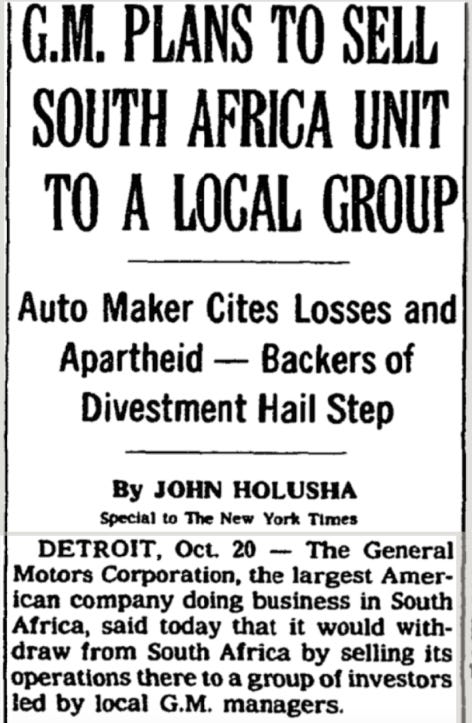
Tim Smith was quoted on the front page of the New York Times, “[GM’s departure] is a tremendously significant decision. Businesses will understand the symbolism of the action, and we expect to see the trickle of companies leaving to turn into a flood.''
Within a month, Eastman Kodak said it would sell assets and halt all product shipments. Coca-Cola announced it would sell its remaining holdings with some proceeds going to local black investors, adding, ''Our decision to complete the process of disinvestment is a statement of our opposition to Apartheid and of our support for the economic aspirations of black South Africans.”
Rev. Leon Sullivan eventually abandoned his Principles, demanding signatory companies to end all commercial ties with South Africa within nine months. He called on companies to stop supplying the Apartheid regime with components, materials, and consulting services, and to ban the use of their trademarks in the country. Within a year, over a hundred American companies sold their South African subsidiaries.
Fifteen years of toil by church activists working on the fringes took off overnight. It was gratifying to have been correct, but even more so to know that each corporate departure added pressure on the South African Government to end Apartheid.
South Africa's economy soon tumbled. A ban on South African participation in international sporting events frustrated many whites. Supporters of Apartheid were no longer accepted in the league of white Christian nations to which they thought they belonged.
Brave South Africans fighting for black liberation, aided by global pressure, brought a reluctant National Party into bilateral negotiations with the African National Congress. Besieged Prime Minister, Frederik Willem de Klerk, met with Archbishop Desmond Tutu to begin negotiations in earnest. As a result, the ban on the African National Congress was lifted and black political prisoners were released, including Nelson Mandela.
Right wing militia groups stormed the South African Capitol to stop negotiations that would lead to the end of Apartheid. Fueled by belligerent rhetoric of right-wing leaders, hundreds of armed white separatists smashed through windows and held senior politicians under siege. Rather than slow change to majority rule, the raid “backfired.”
Even as conditions improved for blacks, church activists held the line. ''Our basic theme is the continuing need for sanctions until there is majority rule,'' said Timothy Smith to the press. “The people we have talked to in South Africa say that pressure should continue. We will be pursuing banks not to roll over loans, companies to cut ties, and the U.S. Government to impose new sanctions.”
After twenty-seven years of imprisonment for being a “communist” and a “terrorist,” Nelson Mandela was elected President of South Africa on May 10, 1994. Twenty million citizens of all races voted peacefully. As church leaders had desperately worked to ensure, bloodshed from a drawn-out civil war was avoided. Mandela was neither a terrorist or a communist as his actions showed after the election. He won the Nobel Peace Prize and became a global ambassador for racial reconciliation as he worked to create a “rainbow nation at peace with itself and the world.”
Apartheid ended but not before tens of thousands died from uprisings and destitute poverty. How many men, women, and children could have been saved had General Motors and others listened to church activists at that shareholder meeting in 1971?
On a goodwill tour of the United States, Archbishop Desmond Tutu personally thanked Tim Smith and church activists, saying, “your economic pressure on South Africa brought the regime to the bargaining table.”
*BONUS MATERIAL*
Paul Neuhauser, who wrote the shareholder resolution presented by Episcopal Church at General Motors in 1971 and became a co-founder of ICCR, tells his fascinating version of the story of how it all happened.