
Nixon Said Make the Economy 'Scream' (1)
JD Vance recently touted a Nixon "renaissance," but if we are to truly remember his statecraft we must understand the former President's legacy in Latin America.

Author’s Note: While my first post explored how an American became a dictator's assassin, we must now step inside the White House itself to meet the geopolitical technicians who set it all in motion.
In the spring of 1971, Orlando Letelier arrived with his wife at the White House as the new Chilean ambassador to the United States. Isabel had been teaching Spanish at Georgetown University and helped organize human rights protests to end the war in Vietnam. The glitzy ballroom was packed with dignitaries in white tie from Latin America.
President Richard Nixon had officially invited the Leteliers to the formal dinner in the State Dining Room. The sparkling event was abuzz in more Spanish than English, but Isabel was seated next to First Lady Pat Nixon. The two moms chatted about the Letelier boys who had been raised in Bethesda, where the youngest was born. Mrs. Nixon graciously signed the table’s gold-sealed menu card and added best wishes to each by name.
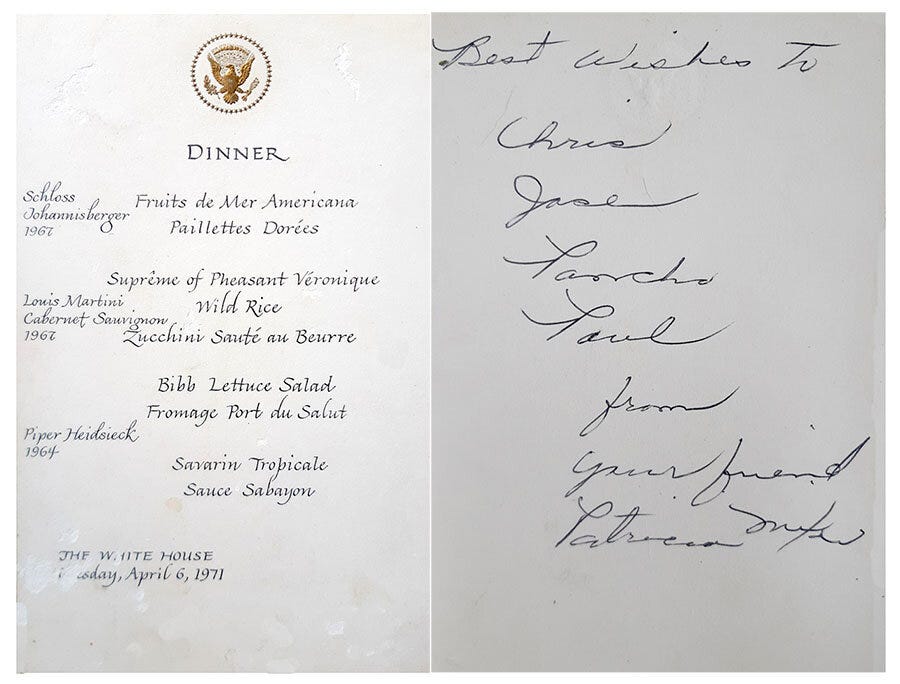
Despite the pleasantries, Orlando and Isabel felt like they were in the lion’s den. He was there representing the government of Salvador Allende, the first democratic socialist elected in the Americas. Nixon considered him a communist and no doubt a potential proxy for the Soviets, with the added complication that Allende had been chosen by the people in a fair election.
A month before that glitzy state dinner, Orlando had been at the White House for his credentials ceremony and had a private conversation with Nixon. I know what happened in that fifteen-minute conversation because of a cable that I found buried in an archive. It was written by Orlando to Allende, and you can feel him trying to decide how much of the conversation to believe.
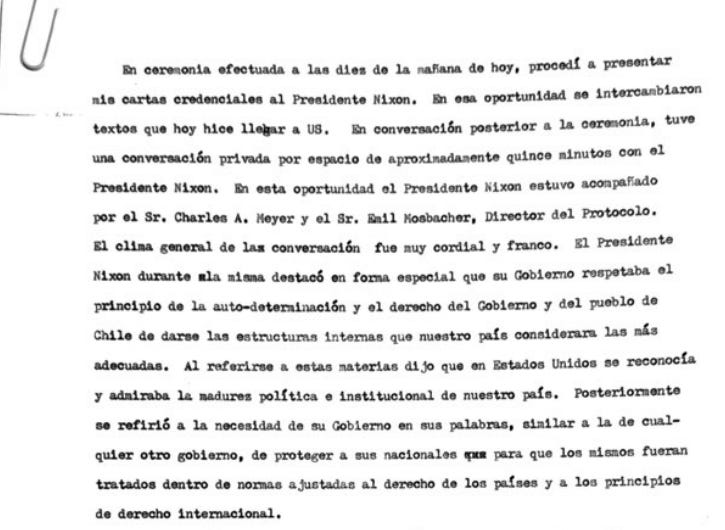
Nixon had said he indeed respected Chile’s right to choose its own internal structures. He repeated “self-determination” three times. Orlando wanted the word of the President of the United States to mean something.
Then Nixon raised the thornier issue of Chile aligning itself with extra-continental powers, meaning the Soviets. The message Orlando got was that Chile’s rights were secure so long as they didn’t interfere with the interests of the United States, which included American corporations there.
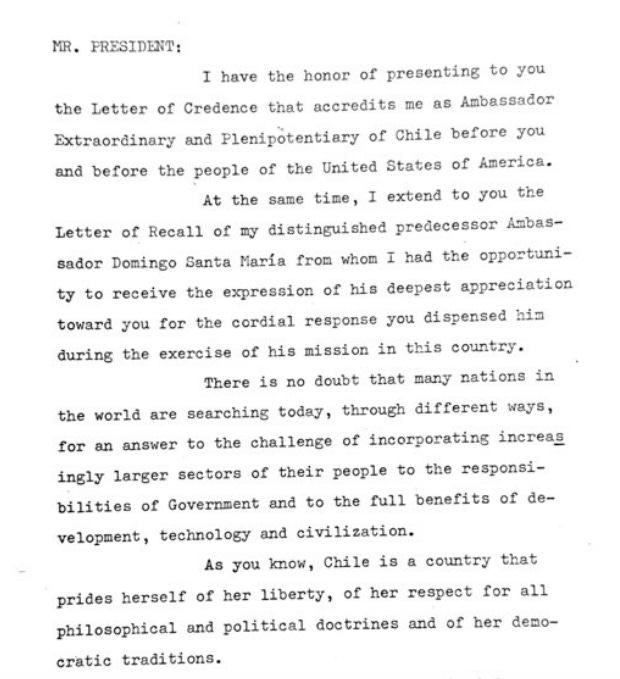
Orlando told Nixon he “deeply appreciates the values characteristic of the American people,” and meant it. But he added that his countrymen had chosen to build “a socialism of their own.” He expected the United States to respect their right to do so.
Nixon abruptly ended the conversation, saying he would very much like to see the Ambassador again soon for a very frank and direct dialogue. He never met privately with the President again, and about the only thing he could trust from that conversation were the veiled threats.
Any serious politician in Washington, from either party, loathed the idea of Allende’s Marxist government taking root. The fear of “another Cuba in the Americas” was a genuine dread following the Cuban Missile Crisis and the Bay of Pigs. Democratically elected or not, the Cold War was the prism through which all actions were justified.
A declassified department memo shows Orlando had also met with Henry Kissinger a few weeks after that fifteen-minute Come to Jesus with Nixon. Kissinger was National Security Advisor at the time and took special interest in the newly elected Marxist in the Americas.
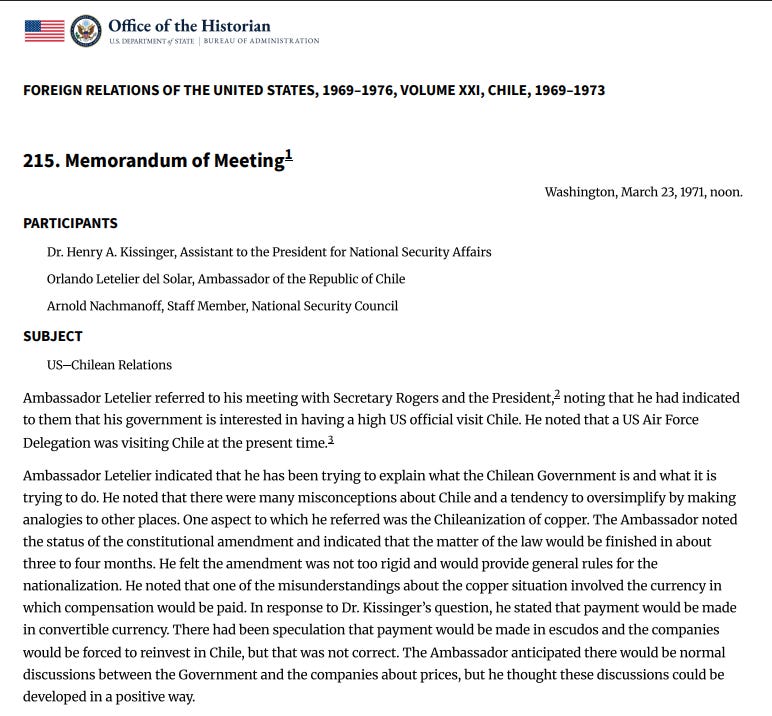
Orlando said there had been reports in the press that the United States was in a confrontation with Chile, which Kissinger dismissed as “nonsense.” America will judge Chile on its foreign policy, "not what it does domestically.” He added that he "will not be the first to break traditional good relations."
All of this was going through Orlando’s mind as Kissinger sat across the room at the white-tie dinner that night. And as the pomp and free wine wound down in the State Dining Room, before the festivities officially ended, Nixon stood before the dignitaries and delivered a nostalgic ten-minute toast about the unbreakable bonds between the United States and its southern neighbors.
“What I am trying to say is,” Nixon told the dignitaries, “that we have a special relationship.” And for good measure, he added, “The relationship is personal over many years, personal going back over so many memories.”
The Letelier family held on to that menu card signed by Pat Nixon, but as events unfolded, the family keepsake became a reminder of what came next.
See what Nixon meant by a special relationship in Part 2.