
Nixon Said Make the Economy 'Scream' (2)
JD Vance recently touted a Nixon "renaissance," but if we are to truly remember his statecraft we must understand the former President's legacy in Latin America.

Author’s Note: In Part 1, the Nixon administration assured Orlando Letelier multiple times that the United States was a friend to Chile. Newly discovered documents reveal what that friendship meant…
A year before that white tie event in the State Dining Room, before the fifteen minutes with Nixon, and Kissinger’s denial, there had been a meeting in the West Wing that Orlando Letelier suspected but could not prove. And even if he could, what good would it do? But as his personal and official documents show, he pretty much knew Nixon was full of it.
Nixon was not going to be the president that allowed another communist country in the hemisphere. He saw what happened in Cuba and the last thing the people of Chile needed was a self-destructive communist dictator. Except, of course, Salvador Allende had been elected by the people. The only solution to the problem was to install a dictator.
For that to happen Chileans needed to fear an Allende presidency—and fast. The only way that would happen in a country like Chile with a long history of democracy would be a military coup.
As declassified documents later showed, Nixon’s view was very clear:
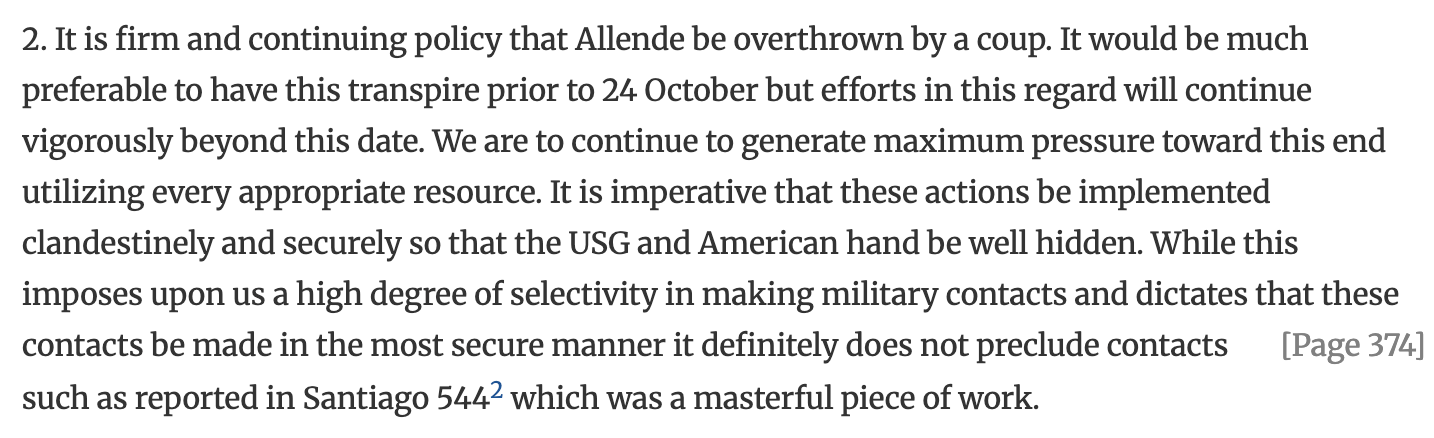
The country’s military of course was mostly right wing, but many were also loyal to their elections and constitution. They needed some convincing so the CIA decided the biggest impediment to a coup before the inauguration was General Schneider, the military’s highest-ranking officer and, as it turned out, a stickler for democracy.
CIA agents were able to find and arm a few rogue members of the military with machine guns and set in motion a plan to kidnap Schneider. What they would do to him afterwards was unclear, but he needed to go. The whole thing was poorly planned and the kidnapping was botched when they shot Schneider.
Nixon was anxiously awaiting a call from Kissinger to find out what happened. Here’s what they said:
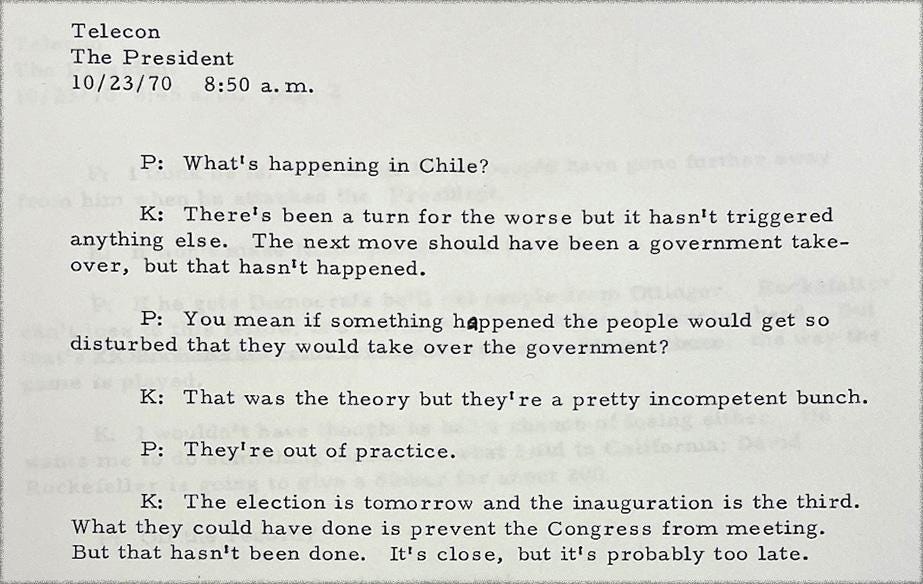
The whole operation backfired spectacularly. General Schneider’s death became a rallying cry in support of Chilean democracy. There were even rumors in the local press that claimed there had been foreign influence in the General’s assassination.
An experiment was born when Allende was inaugurated as the 29th President of Chile. For the first time the world would see what it was like to have communism in a democratic system. But Nixon’s response had already been decided given the zeitgeist of the Cold War. Even before the inauguration, he had famously ordered the CIA to make the economy in Chile “scream.”
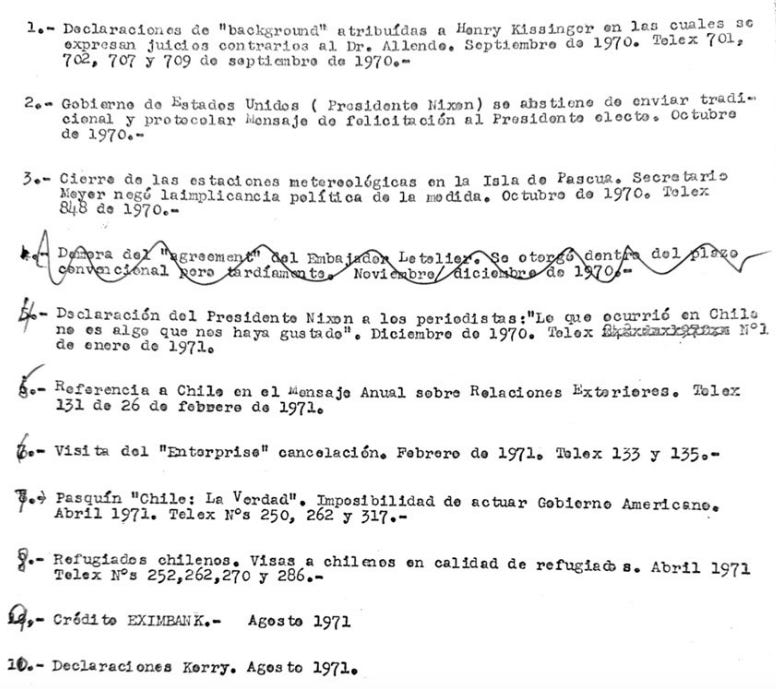
By the time Orlando Letelier became the ambassador in Washington, he had collected at least ten instances where the United States had acted against Chile, including hostile remarks to the press, withholding customary diplomatic protocol, and the cancelling of a visit by U.S. diplomats.
Then someone broke into the Chilean Embassy in the middle of the night. Orlando thought it was suspicious because whoever it was didn’t take any cash or expensive equipment. They just rifled through some sensitive diplomatic documents related to Chile’s copper industry. When he explained this to FBI agents on the scene, they concluded the break-in was too sloppy to be state-sponsored, and left it at that.
Letelier wrote to Santiago, in a letter I discovered, that reporters at the Times and the Post, along with other officials, had good information that the men who broke into the Chilean embassy were the same ones caught the following month breaking into the offices of the DNC at The Watergate Hotel. Who was behind the break-ins was still unknown.
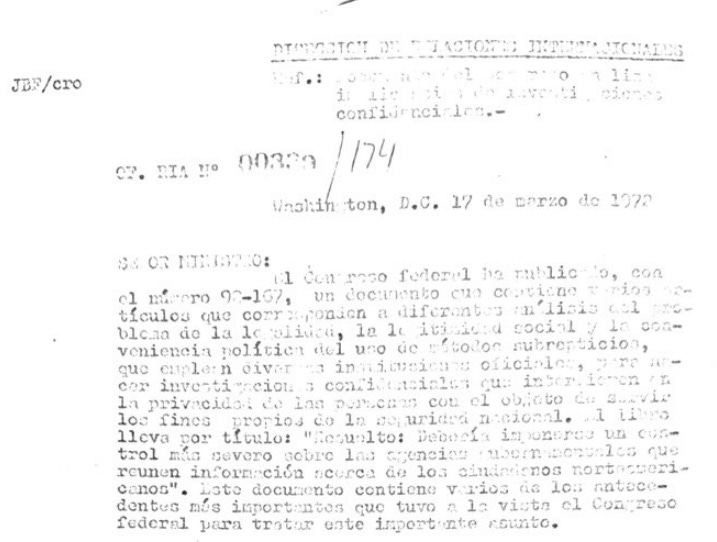
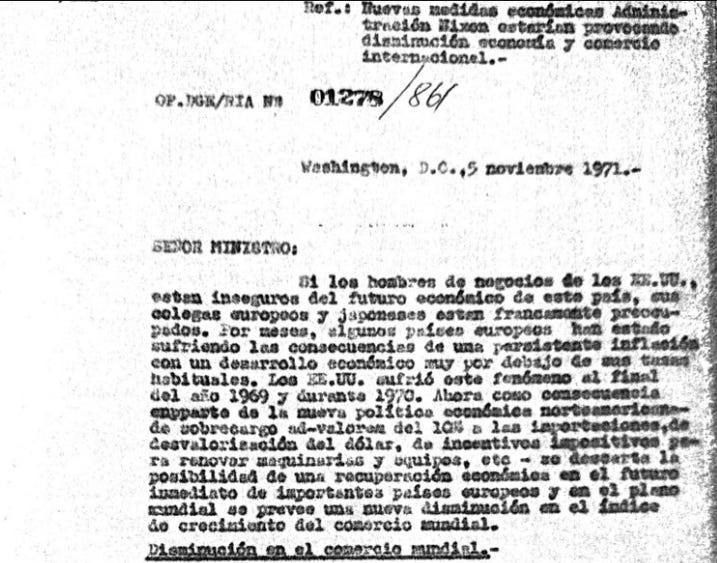
What mattered most to Orlando was Nixon’s economic shock therapy. He wrote a four-page analysis that said the administration was responsible for a dollar devaluation, a delay for international loans, and a ten percent tariff on goods from Chile. In this economic report I found written in Spanish by Orlando, he made it clear to Allende that a trade war was underway.
Nixon’s and the CIA’s efforts to destabilize Chile pushed Allende to make increasingly poor policy decisions in the face of an ongoing economic crisis. The upper classes in Chile were also undermining the economy in response to proposed policies that would lead to the appropriation of private property.
By May 1973 there were so many bread lines and demonstrations, and so much chaos in the streets of Santiago that Allende asked Orlando to return. Too many of his cabinet ministers had been sullied by the press, a military coup was on the horizon, and he needed people around him that he could trust.
The entire Letelier family decided to move back to Chile with their father, even though the boys were perfectly happy in Bethesda. Isabel, ever the fighter and supportive wife, would be by her husband’s side no matter the consequences.
Orlando Letelier started as the Foreign Minister, then in quick succession the Interior Minister, and finally as Defense Minister, the second most dangerous job in a country. He was the head of the military right as whispers of an impending coup to “save the country” were at a fever pitch.
A few months later, on September 11, 1973, Nixon finally got what he wanted. A military junta led by General Augusto Pinochet successfully bombed the government into submission. As insurrectionists marched toward his office in the Presidential Palace, Salvador Allende committed suicide.
Thousands of suspected communist sympathizers were rounded up, severely tortured, killed, or “disappeared.” As a prized government minister, Orlando was beaten, shot in the leg, and sent to a concentration camp off the Strait of Magellan, somewhere between Chile and Antarctica.
What he endured in that year of captivity is for a future story, but Orlando was finally released and then expelled from Chile with a one-way ticket to Venezuela. It was odd that Pinochet allowed him to leave the country and it was a decision that the General would soon regret.
Though Orlando was sequestered in a concentration camp for most of the Watergate scandal that engulfed Nixon, he was released into exile just as the disgraced president resigned. Even if it was too late for him and his countrymen, the whole world now knew what he had been saying for years—Richard Nixon was a liar.
The Leteliers eventually moved back to Washington as exiles. Orlando had been traumatized by the torture and was intensely motivated to get justice for his dead colleagues and those still under arrest without charges. It wasn’t easy; he was, after all, in the country that had created the conditions that led to Pinochet, a staunch new ally in the Cold War.
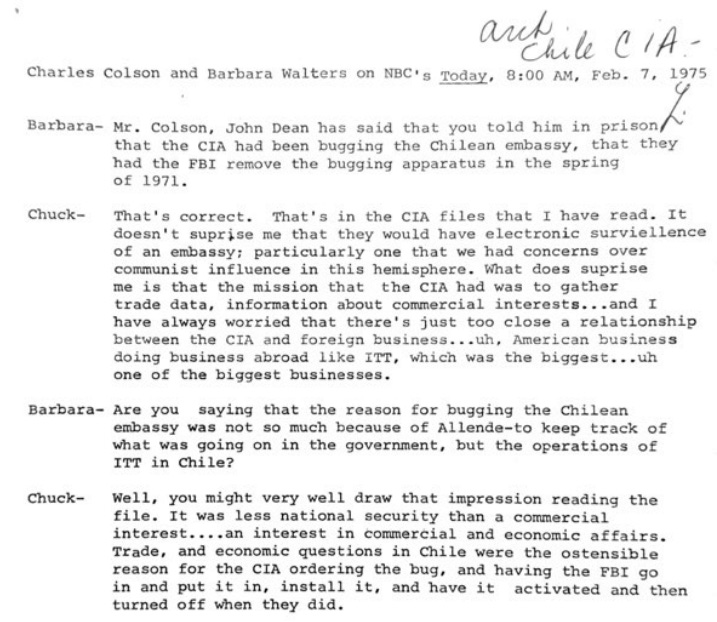
One of Nixon’s “plumbers” was interviewed by Barbara Walters on NBC’s Today show a few months after the resignation. He told Walters that the CIA had bugged the Chilean embassy in Washington. Here’s a transcript Isabel kept of that conversation:
In time, Orlando Letelier became a singular figure in the global movement to deliver justice to the Pinochet regime. Nobody had a higher profile and he had channeled his considerable contacts to make as much noise as humanly possible to shine a spotlight on the reality in Chile. His efforts did not go unnoticed in Santiago.
On a muggy morning in September of 1976, as Orlando drove by the Chilean embassy where he once lived, a remote-controlled bomb detonated under his car. It killed him and his colleague Ronni Moffitt, a newly married twenty-five-year-old from New Jersey. She and her husband Michael were catching a ride to work because their car had broken down the day before.
Michael was in the back seat and survived the blast. He walked out shouting to anyone who would listen that Pinochet had killed his beautiful young wife.
It’s impossible to know if Kissinger knew about the bomb ahead of time, but five days before it detonated the State Department had written a memo for the Pinochet regime that would have explicitly ordered him to stop murdering political enemies abroad. Before it was delivered, Kissinger killed the memo and ordered that “no further action be taken on this matter.”
In the weeks following the assassinations, the CIA, under George H. W. Bush, steered investigators away from their Cold War ally General Pinochet. The Agency leaked theories that the explosive device used was too crude to be government-sponsored, and instead blamed leftist radicals.
Burying the truth allowed the Nixon and Ford administrations to insulate themselves from headlines about the assassination of a former diplomat they once shared bread with, and a young American woman who bled to death on Embassy Row. Ever the technicians, they saw it as an unfortunate consequence to a necessary evil.
A comprehensive review by the CIA, later declassified, confirmed what everyone at the time suspected or knew: General Pinochet personally ordered the assassination. That document became public forty years too late because Pinochet died of old age before he could be tried for those murders.
It had been a rough, traumatic road from that glittering white-tie dinner at the White House where Pat Nixon signed a menu card for the Letelier boys. But Isabel Letelier kept it among her memories. The signed card outlasted the coup, the torture, the exile, the bomb, the dictatorship, surviving even after democracy returned to Chile and Orlando Letelier’s dream came true. Their son Francisco shared an image of that gold-sealed card in an article he wrote about that time his parents dined in the lion’s den.
Fifty years after the bombing, we as Americans also get to choose what to remember. Are we brave enough to face the whole truth or only remember the skill of our technicians? What Vice President JD Vance recently called a Nixon “renaissance” is a great opportunity to see if we will remember our history in full—warts and all.
Ryon. This is so interesting. I was unaware of the evil and cruelty in the Nixon administration. I knew about Watergate crimes and Nixon stepping down as President. But I guess we really don’t know what all happens in each Presidental Administrations,