
American-Born Executioner Wanted for 'Crimes Against Humanity' Faces Deportation in Miami
Next week, a Miami judge will decide the fate of a key figure in The Technician. Before the Letelier assassination, he helped lead the infamous "Caravan of Death." This is his story.

Author’s Note: ICE Agents recently arrested Armando Fernandez as one of “the worst of the worst” for his part in assisting Michael Townley in the bombing of Orlando Letelier. Here’s why Fernandez is wanted by the Supreme Court in Chile for “crimes against humanity.”
Around 06:00 on September 11, 1973, Armando Fernandez was awakened by his commanding officer and told to suit up. He was a young lieutenant in an elite unit, but he had never seen real action. It was all very hush hush, but they were told that there had been credible intelligence of an imminent “Marxist uprising,” that they needed to “save the fatherland,” and to immediately secure the capital’s strategic intersections.
The military coup everyone had anticipated in Chile was happening. It seemed the days of President Salvador Allende’s term were numbered and that the bustling streets of downtown Santiago would be a war zone.
Armando was born in Washington, but he wasn’t an American citizen. His father had been living in the United States as a military attaché with diplomatic immunity, so the boy was born under the jurisdiction of Chile.
Back in their homeland, he was raised in a military village, attending the same schools and in same family circles of the other officers. When he was old enough to serve, Armando trained at the Combat Arms Orientation course at the U.S. Army School of the Americas in Panama.
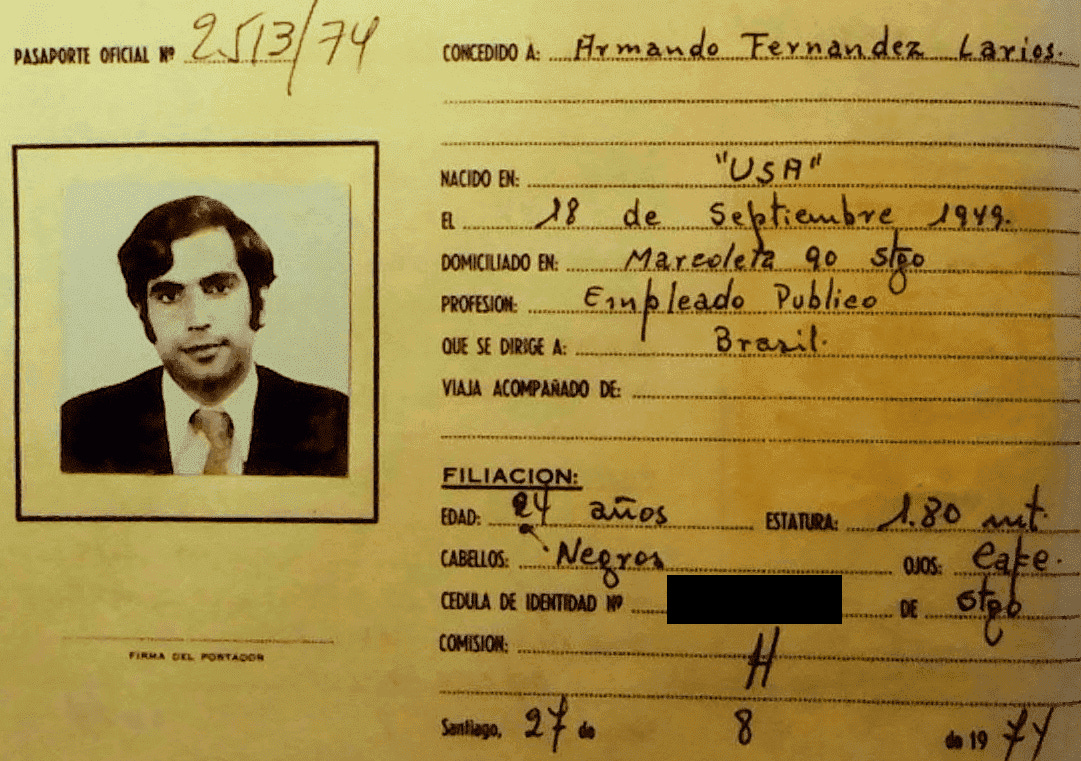
By the morning of the coup, the “baby-faced” lieutenant with the shaggy brown hair was only a week from turning twenty-four, but had been in the military his entire life.
On his way to the presidential palace, Armando would have remembered his father. No matter how badly things had gotten in Chile, the retired colonel hated the idea of a military coup. Alfredo Fernandez was old school; from a generation of officers who believed the military should remain professional, apolitical, and subordinate to the constitution. An assault on the presidential palace was an unacceptable breach of that institutional oath.
But he would have also taught his son that a good soldier obeys orders.
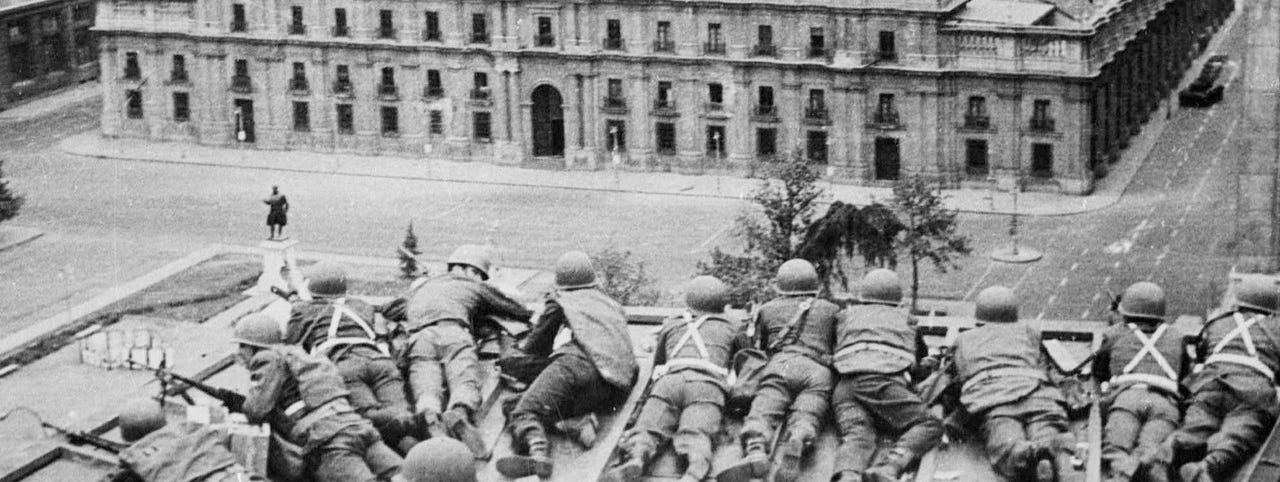
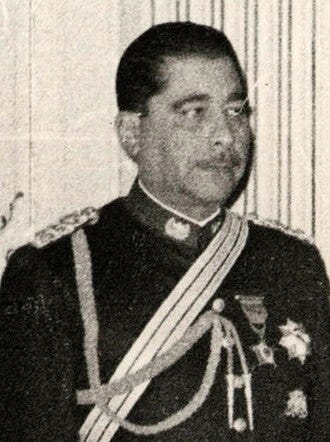
General Ortega was Armando’s commanding officer that morning and ordered his men to surround the presidential palace to face whatever resistance they got from loyalists inside. Thousands of troops waited in the wings to support them.
Everyone was confident that the overwhelming might of all three branches of the military and the police force could easily take on a few dozen government bureaucrats, even if they were hardened communists.
By 08:00, the military had taken over the airwaves and broadcast their first radio proclamation, demanding that President Allende, who was holed up in the palace, surrender immediately. If he agreed to resign, they offered him a helicopter to fly him and his family out of the country.
Allende responded that the President of Chile does not flee, and then delivered a defiant final live broadcast, telling the nation he would pay for their loyalty with his life. He said not to take up arms against the junta, that the people must protect themselves but not sacrifice themselves.
Minutes later, Hawker Hunter fighter jets bombed the station’s radio transmitter.
Armando Fernandez was part of a column of infantrymen and a heavy tank squadron that established an iron ring around the palace in downtown Santiago. When a final ultimatum by the junta to surrender was ignored, the command to fire was issued by Army General Augusto Pinochet.
Fernandez and hundreds of infantrymen began shooting into the windows of the palace. Tanks blasted shell rounds directly into the historic concrete façade of La Moneda. Hawker Hunter fighter jets roared overhead, swooped toward the roof, and dropped two bombs that set the structure ablaze.
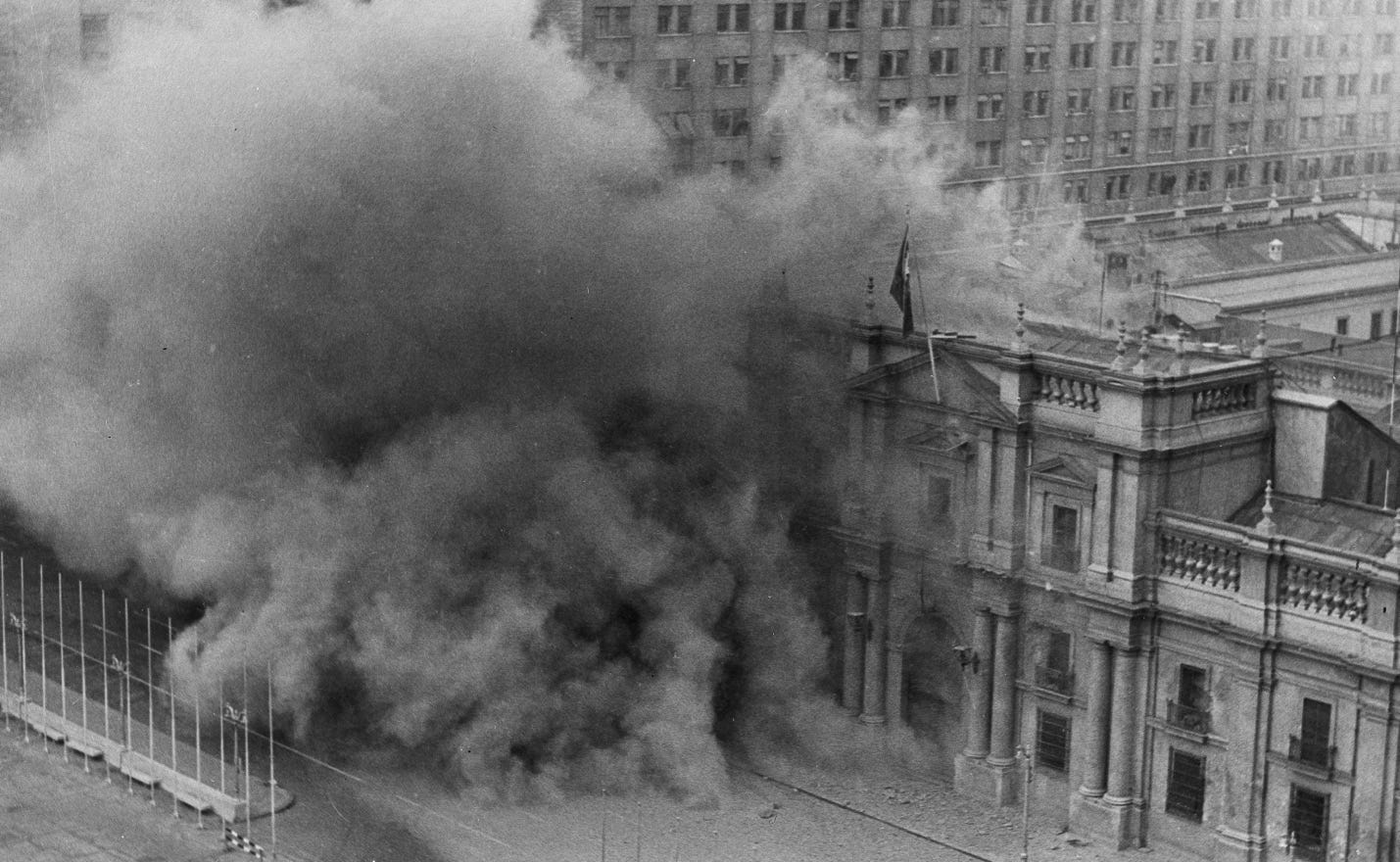
Armando Fernandez was among the first to breach the palace walls. He might have even heard President Allende shoot himself with an AK 47 that had been gifted to him by Fidel Castro. Allende’s body was carried out through a side door of the palace where Lieutenant Fernandez and General Ortega were captured in a photograph.
The military coup was a resounding success: they had eliminated Allende, rounded up most of his top ministers (including Orlando Letelier), and captured scores of officials at military stations across the country. But as far as the generals were concerned, the mission wasn’t over.
If the communists were allowed to regroup, it would surely start a new civil war that would kill many more Chileans. But if the junta cut off the head of the opposition right away, they reasoned, there would be no men to lead an uprising.
On September 30, 1973, nineteen days after the coup, Armando Fernandez left Santiago on a mission aboard a twin-engine transport helicopter called a Puma. As one of the most trusted men on the squad, he was assigned to the personal detail of the commanding officer, Brigadier General Arellano Stark.
An imminent communist uprising was still the official story, wherever it led, and the soldiers had to act accordingly or risk being called traitors. The Chilean military code was based on Austrian tradition and Lieutenant Fernandez would have responded to any order with, “yes my general.”
People were already terrified of the communists in the country which made it easier to swallow a state of emergency. It loosened the legal bounds to the point where the junta could act decisively.
General Arellano carried a document accrediting him as a delegated officer of the new Commander in Chief, Augusto Pinochet. The stated mission was “to standardize criteria for the administration of military justice and to accelerate the war councils.”
Lieutenant Fernandez and his squad helicoptered south first and stopped at military bases where government officials had been held since the first day of the coup without charges. In the first half dozen cities they executed dozens of prisoners. Judge. Jury. Executioner.
To think that a few years earlier those officials had celebrated being appointed by the democratically elected president to a position in local government; now they were beaten, tortured, and marked for death. Without any sort of trial, they were simply being killed for being government officials.
To Lieutenant Fernandez and his squad, they were exterminating dangerous communist scum who would have done the same to them in kind. Even if they weren’t all dangerous, the rest of the commies would get the message and think twice about an actual uprising.
Having finished their tour down south, the Puma landed in the northern city of La Serena. They commandeered the files of the local military prosecutor, quickly circled the names of specific detainees, and ordered their removal from the public jail on the spot. No explanation or decree necessary. The ones circled in red were transported to the local regiment’s firing range.
Fifteen prisoners were lined up side by side and executed one by one, including the conductor of the local youth symphony orchestra. Their bodies were hidden in a mass grave prepared beforehand.
On October 16, 1973, Fernandez and five other members of General Arellano’s squad arrived at the Copiapó military garrison.
An aide to the local garrison commander later testified that Lieutenant Fernandez had bragged about being Arellano’s right-hand man, and that the curved knife on his vest would be used to “caress the little pigeons.” He invited an officer there to join them for “una fiesta“—a party, a term understood as an invitation to participate in torture and execution.
A prisoner interrogated that night later testified that he saw Fernandez with Arellano as the general circled the files of thirteen prisoners to be “eliminated.” Another witness testified to seeing Fernandez himself selecting and reviewing the files. Clearly, he had gained his general’s trust.
Two prisoners were shot before the military transport arrived to the jail after midnight. The other eleven, hands bound behind their backs, were marched past the two corpses and tossed into the truck.
Witnesses said the members of the death squad had been drinking heavily that evening. Lieutenant Fernandez, acting alongside the rest of General Arellano’s unit and two additional military officers, drove the prisoners roughly ten minutes outside of the city.
On a moonlit desert road, Armando Fernandez and the other officers ordered the government officials to step out so they could be executed by stabbing or gunfire. Some of the men refused to get off the truck, so Fernandez and other squad members climbed in to deal with them.
Among the panicked prisoners was Winston Dwight Cabello (named after Churchill and Ike). He would have pleaded with the soldiers to release him, insisting he was just a regional director and not a member of a militia. And that his file had already been reviewed and that he was told his release was imminent.
Armando Fernandez slashed Cabello from ear to throat using a crescent-shaped knife designed to cause a prolonged and painful death. Two men of the same generation separated only by different ideas about politics.
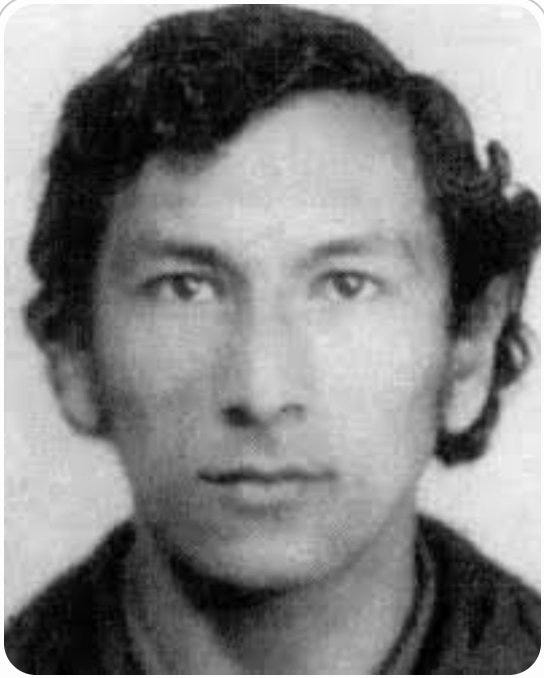
Later, a local official asked by the military to identify the bodies testified that Winston Cabello had cuts on his ear and a gaping wound running from the ear to the throat. The doctor who examined the exhumed body found tears in the clothing and blood stains consistent with wounds from a corvo.
Years later, in a United States civil court, Armando Fernandez admitted that he had the only corvo in Copiapó and had not loaned it to anyone, testifying that he carried the weapon as an “ornament” on his uniform.
On October 18, 1973, the local newspaper falsely published that thirteen political prisoners had been killed while attempting to escape.
Chilean military officials deliberately withheld Cabello’s burial location from his family. They received three successive and conflicting death certificates: one stating execution by the military, a 1985 revision giving gunshot wound as the cause of death, and a third in 1991 omitting the cause of death entirely. The clandestine grave was located seventeen years later, and the exhumations revealed that many of the victims had been slashed with corvos.
The Eleventh Circuit Court in the United States found that the evidence established a conspiracy in which Fernandez’s squad participated in the killing of at least 72 civilians, and that the admitted evidence showed he was personally responsible for killings in La Serena, just prior to the incidents in Copiapó, and also for acts in Antofagasta and Calama.
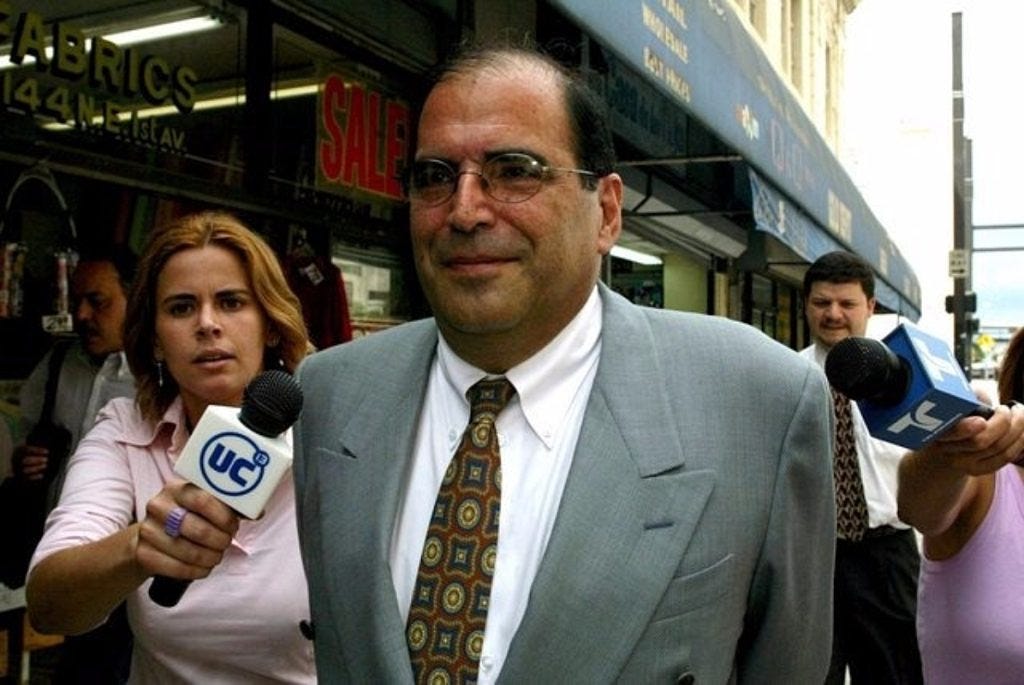
Having proved his mettle in what became known as the “Caravan of Death,” Armando Fernandez was recruited by DINA, an intelligence unit that reported directly to the leader of the military junta, now President, Augusto Pinochet. Maybe because of where Armando was born, his code name was “the eagle.”
In DINA, he began working alongside another operative: an American technician who had immigrated to Chile as a teenager when his father was posted there as an executive of the Ford Motor Company. The operative, commonly known as el gringo, was Michael Vernon Townley.
In 1976, the two men born in the United States, colluded to car bomb the opposition leader, Orlando Letelier, a mile from the White House. It was the most brazen act of international terror on American soil in two hundred years.
When Armando told his father that he had joined DINA, Alfredo Fernandez examined his son’s official badge.
“Armando,” he said, “please leave DINA ... Return to the Army. You were born a military man. You weren’t born an intelligence agent … You have to resign. Tomorrow.”
When Armando dismissed his old man’s advice, the retired colonel delivered a premonition:
“I know you. And I know you are loyal to your superiors, but none of those superiors are going to protect you. One day you will go to jail, and I won’t be alive to help you.”
A year after his father’s death, Armando’s role in the Letelier bombing became global news. He turned himself in to the FBI in 1987 to “clear his name,” and ultimately spent five months in federal prison for his intelligence role in the Letelier assassination. In exchange for a lenient sentence, he gave hearsay evidence that Pinochet had ordered the assassination.
In 1990, a mass grave near La Serena and others were found. Fifteen bodies were exhumed, and investigators found that many had been killed by the blade of a corvo.
In 2003, he was found liable in a civil suit for the murder of Winston Dwight Cabello Bravo in a U.S. District Court for the Southern District of Florida and was ordered to pay $4 million, which he never paid.
Armando Fernandez has multiple murder charges in Chile, but there can be no trial without him present. That could change in a deportation hearing scheduled on August 5, 2026.
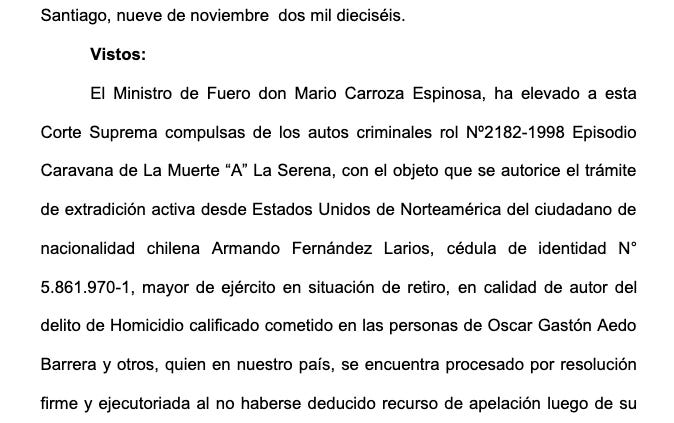
Below is the Chilean Supreme Court’s fifth request that Armando Fernandez be extradited from the United States to Chile for his “crimes against humanity” during the “Caravan of Death.”
Post Note: After being arrested by ICE, Armando Fernandez surprised everyone by saying he had an agreement with the federal government that says he can’t be deported. At a hearing in Miami this August 5th, a federal judge will decide if Armando will stay in the United States, be deported to a different country, or return to Chile to face murder charges in at least five criminal cases.